I shared this message today at the Concord Seventh-day Adventist Church. Scroll to the end to see the full slideshow.
i
Opening Hymn: 83 Oh Worship The King
Scripture Reading: John 18:36
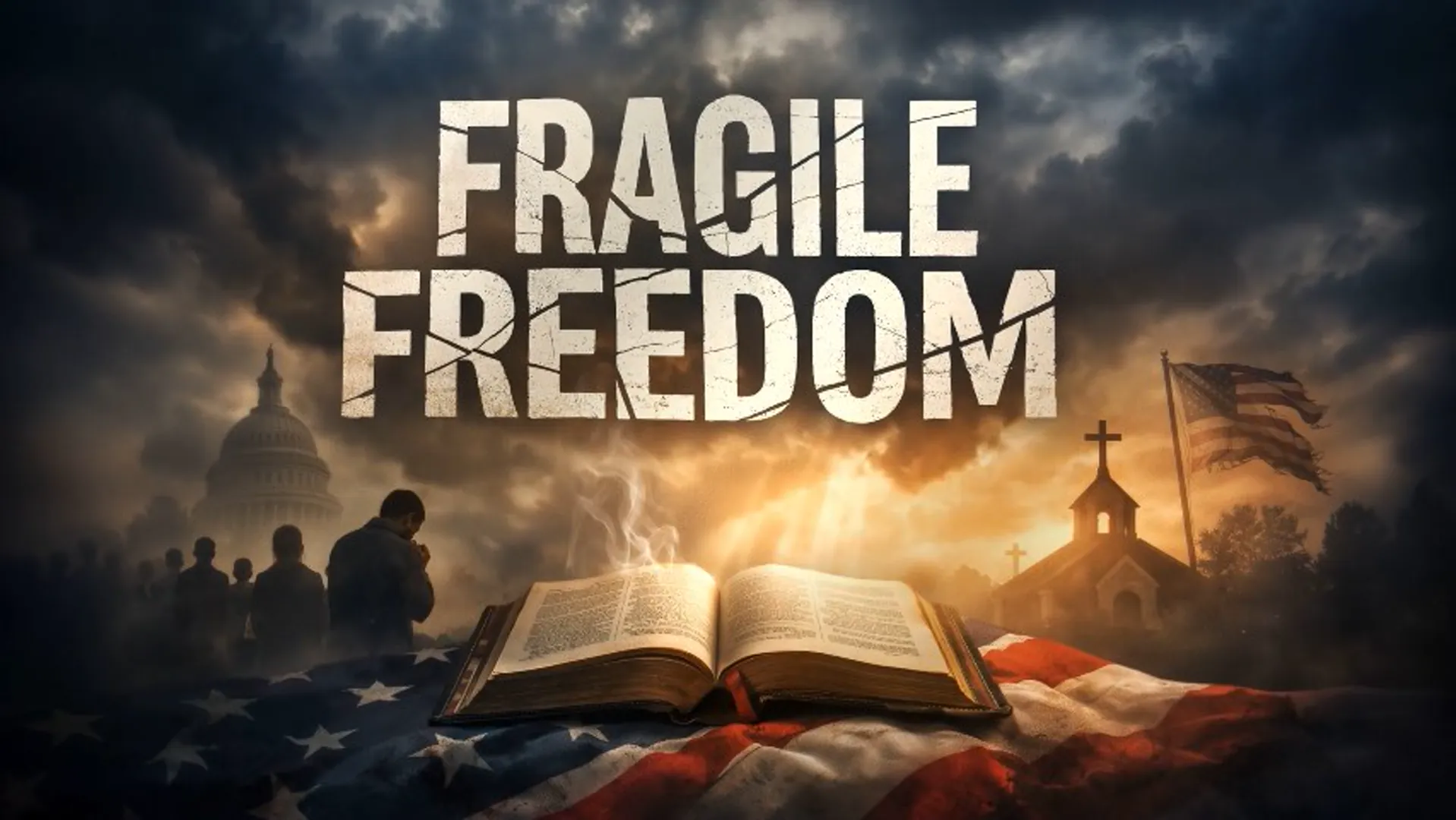
Sermon Title: Fragile Freedom
Closing Hymn: 92 This Is My Father's World
i
Journey with me to Scotland, where Kristina and I traveled last June. We had just traveled by bus from Oban, having visited the island of Iona where Colomba brought Christianty to Scotland from Ireland centuries ago.
We're walking the narrow streets around the university of St. Andrews. You can see the spire of St Salvator's Chapel, one of two collegiate chapels at the university. This one was founded in the mid-15th century--a very different time than the one we live in today. As we peer through the gate you can see one of the lawns of the university, and the outside of this beautiful chapel.
You may even recognize some of the pastors from this conference in our group!
But let's go back to this spire and this chapel for a moment. Travel with me back in time 500 years to the story of a young preacher who taught within these walls.
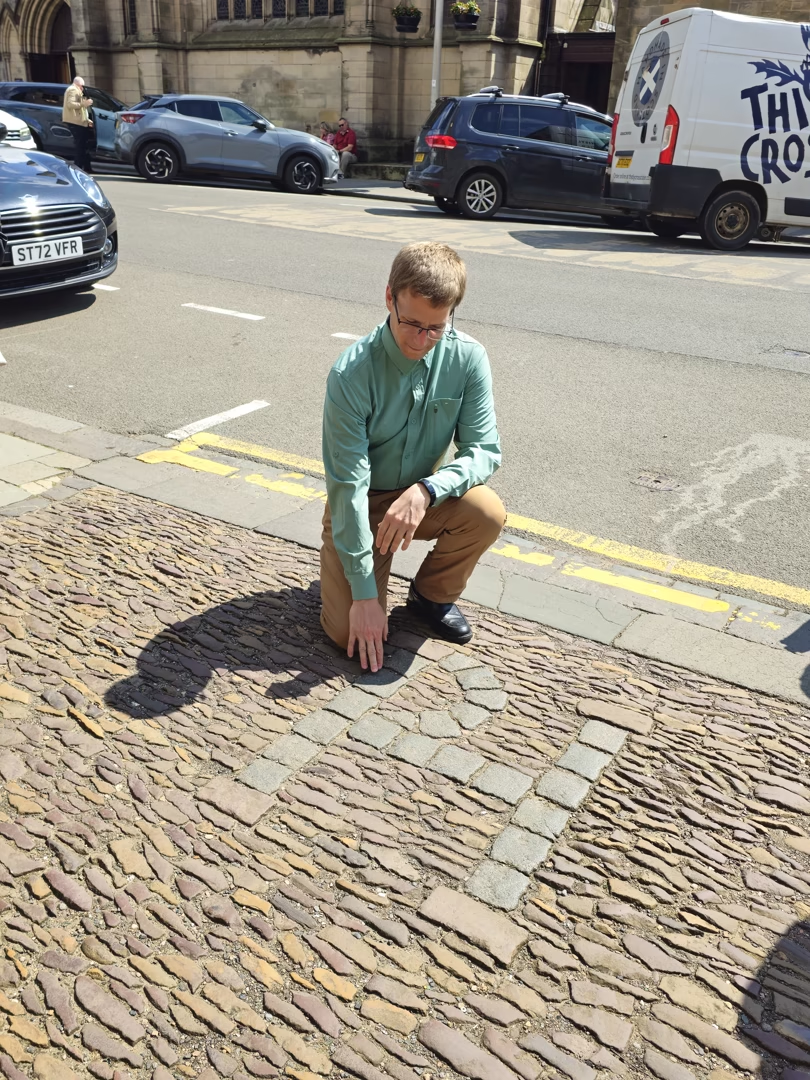
On the other side of this spire, in front of the entrace to the chapel, you can see a curious mosaic of stones forming the initials P.H.
i
An unassuming monogram...
i
This plaque tells the story...
i
Patrick Hamilton was born to a noble family. He was highly educated within the context of the Catholic church. During his education, he traveled to the continent, where he first encountered the writings of Martin Luther in Paris. Hamilton was struck by the clarity of the gospel: justification by faith alone, not by works or penance, as taught by the church.
When Hamilton returned to Scotland in 1527, he chose St Andrews—the intellectual and ecclesiastical center of the nation—as the place to teach. His preaching was measured, academic, and pastoral, yet it directly challenged the prevailing assumption that the church possessed coercive authority over conscience. His short treatise, later known as Patrick’s Places, distilled Lutheran theology into propositions that made the freedom of the gospel unmistakable.
Eventually, Hamilton was summoned before a council of bishops and clergy. He faced thirteen charges of teaching heresy, but he wouldn't give up his belief in God's grace.
i
Hamilton was sentenced to death, and at the age of only 24 was burned at the stake at the entrance to St. Salvator's Chapel on the campus of the university where he had taught. As he perished in the flames, his last words were "Lord Jesus, receive my spirit."
But rather than putting an end to the teaching of God's grace, the news of Hamilton's death became the catylist for many others to investigate the teachings of the Bible.
i
Evantually this monogram of Hamilton's initials was placed in the stones outside St. Salvator's Chapel. To this day, students at the university will avoid stepping on the monogram for fear of being cursed and failing their exams!
i
I've titled today's message "Fragile Freedom," because over the next few minutes together I'd like for us to consider what it means to be able to worship, believe, and teach according to the dictates of ones' own conscience.
I don't have time to even begin to share with you about the many other places we visited on our journey to England and Scotland. Of the drama that took place in the court of King Henry VIII, as he took England headlong into protestantism--for all the wrong reasons. Or of his successor, his daughter Mary Tudor or "Bloody Mary," who attempted to violently reverse the English reformation and take the country back to Catholicism.
i
I don't have time to tell you of the pilgrims who left the old country and sailed to this land of America in search of a place where they could practice their faith without interference from the king. Or of how even these new settlers in this land began to persecute their fellow Christians right here in America.
i
I wish I had time to tell you the story of Roger Williams--how he became a champion of religious liberty, of the separation of church and state.
"...the hedge or wall of separation between the garden of the church and the wilderness of the world..."
i
Williams spoke of this "hedge or wall of separation between the garden of the church and the wilderness of the world"
he realized that having freedom for myself, or for those who think link me, isn't enough. How true freedom requires giving others the freedom to disagree, and establishing a secular government that allows its citizens the freedom to think, to believe, or not to believe at all.
This principle of religious freedom became a cornerstone of the government of this country after its founding in 1776. Before the constitution was ratified by the states, it was amended by the bill of rights. The first amendment to the constitution states
"Congress shall make no law respecting an establishment of religion, or prohibiting the free exercise thereof...
...or abridging the freedom of speech, or of the press; or the right of the people peaceably to assemble, and to petition the government for a redress of grievances."
i
Thomas Jefferson called this a "wall of separation between church and state." This doctrine of Roger Williams, now enshrined in the constitution, provided an atmosphere of freedom that opened the door for great advancements, not only in a proliforation and advancement of religious ideas, but to advancements in science and almost every other area of education.
i
I find it surprising, though, that in recent years this idea has come increasingly under attack. It seems the adage is true: those who fail to learn history are doomed to repeat it.
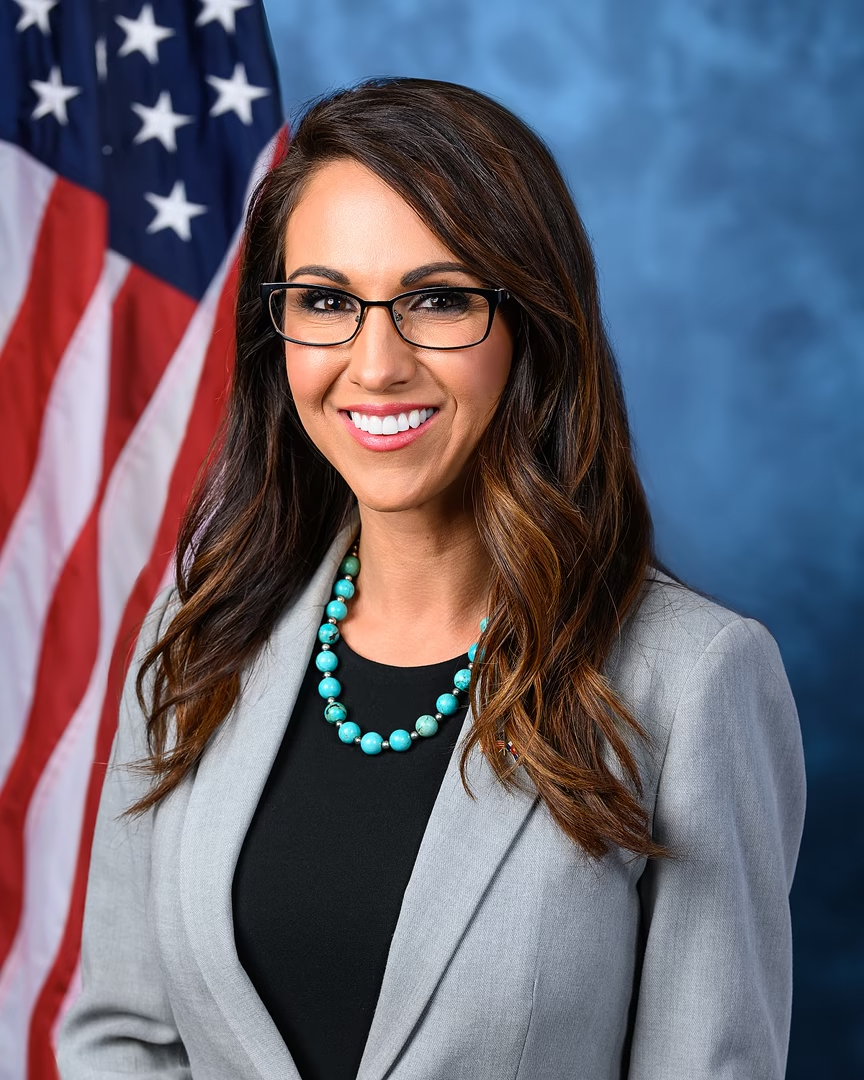
Take, for instance, this quote from representation Lauren Boebert, from a speech at a church in Colorado in 2022...
“I’m tired of this separation of church and state junk — that’s not in the Constitution. It was in a stinking letter and it means nothing like they say it does...”
Rep. Lauren Boebert (R-Colorado)
“The church is supposed to direct the government. The government is not supposed to direct the church. That is not how our Founding Fathers intended it.”
Rep. Lauren Boebert (R-Colorado)
i
That was her view of separation of church and state: "the church is supposed to direct the government."
That's exactly what the church did in 1528, when the church told the government we, "need to kill Patrick
Hamilton because he's teaching heresy." When the church directs the government, church can use the power
of the government to enforce her particular dogmas.
(regarding separation between church and state)
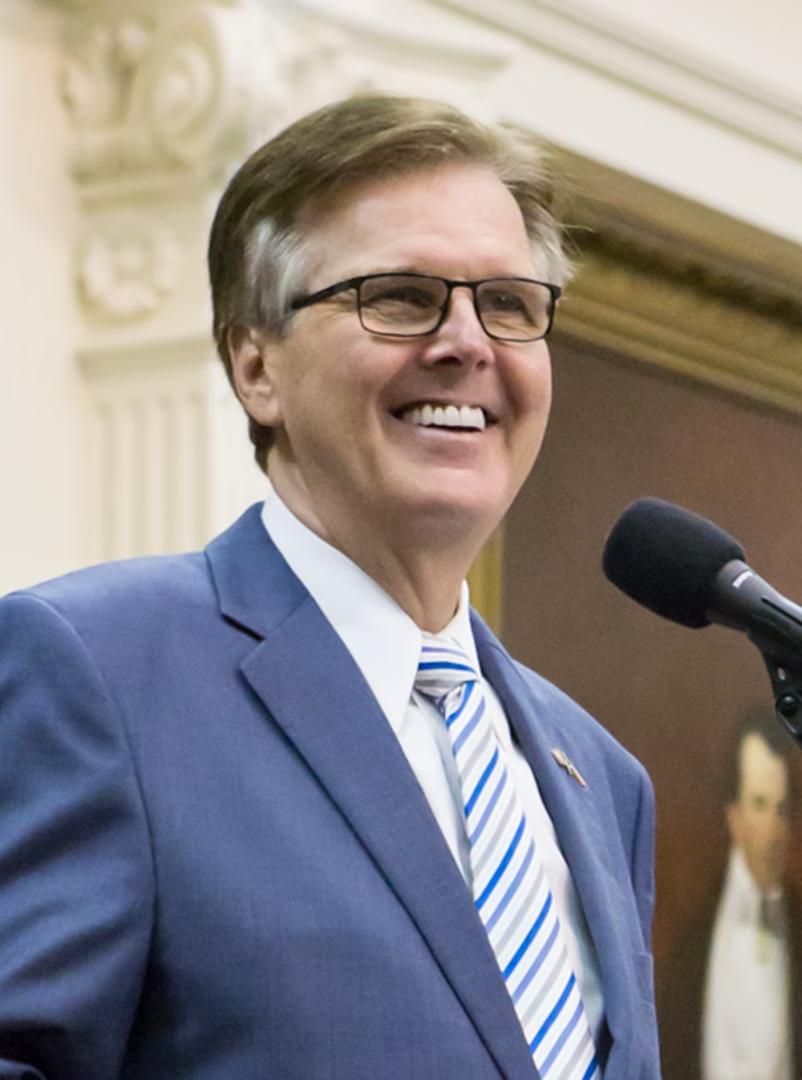
"...[the] biggest lie that’s been told in America since our founding"
Texas Lt. Gov. Dan Patrick
Chairman, Religious Liberty Commission
April 13, 2026
i
This quote was in the news this past week. Last year, President Trump formed the "Religious Liberty Commission," a federal advisory body tasked with creating a comprehensive report on "the foundations of religious liberty in America, the impact of religious liberty on American society, current threats to domestic religious liberty, strategies to preserve and enhance religious liberty protections for future generations, and programs to increase awareness of and celebrate America's peaceful religious pluralism." While upholding lofty goals, the makup of this body has been criticized for lacking diverse representation, as it is composed largely of certain groups of Christians.
The final hearing of this Religious Liberty commission was held in Washington DC this past Monday. As reported by USA Today:
Members of President Donald Trump's Religious Liberty Commission criticized
notions of a necessary separation between church and state at the group's final
hearing in Washington, DC, on April 13 [2026].
Texas Lt. Gov. Dan Patrick, the commission's chairman, at one point called it
the “biggest lie that’s been told in America since our founding.”
...
Americans United for the Separation of Church and State called Patrick's remarks "an attack on our democracy."
The separation of church and state "is an American original, something we should be proud of, fight for
and cherish," said Rachel Laser, the organization's president and CEO.
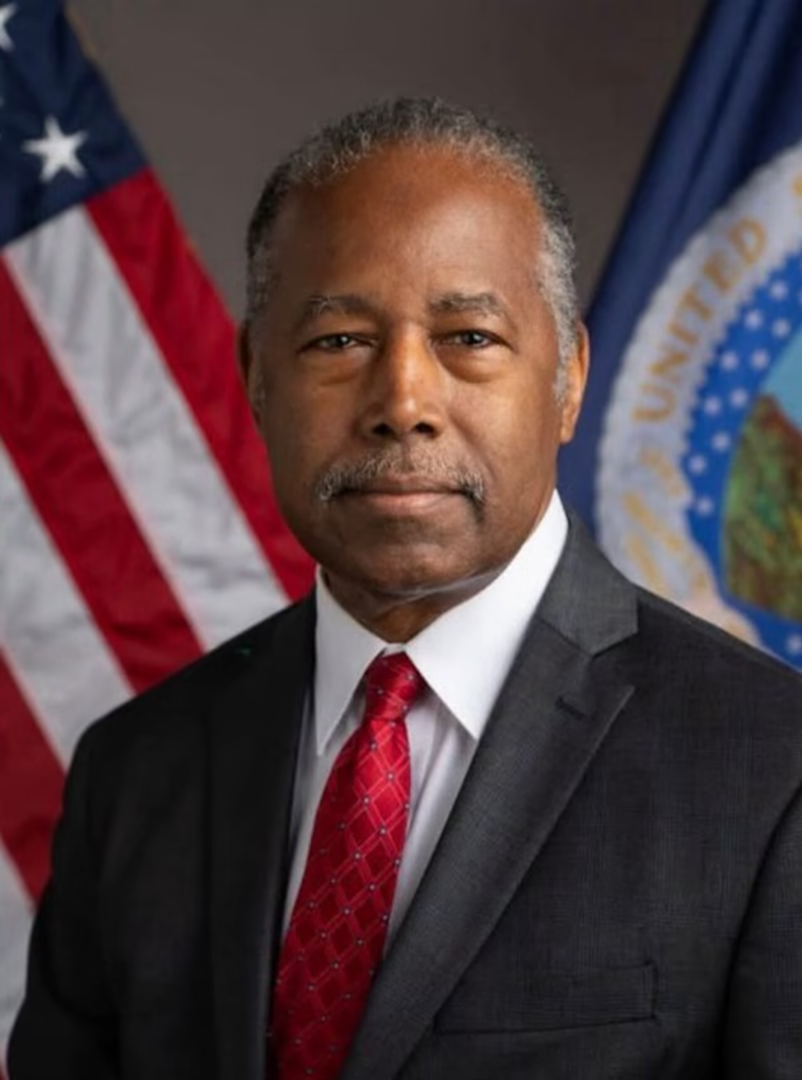
Notice again that these remarks were made by the chairman of the commission. The vice-chair of this commission is Ben Carson, who is himself a Seventh-day Adventist. I want you to notice this comment he made several years ago, when he served as Secretary of Housing and Urban Development.
"...separation of church and state means that the church does not dominate the state, and it means the state does not dominate the church. ...”
Ben Carson (October 2019)
Current Vice Chair, Religious Liberty Commission
i
Now this sounds reasonable enough, but the quote continues
Ben Carson ... referenced separation of church and state during an opening prayer before a cabinet meeting.
"... It doesn’t mean that they cannot work together to promote godly principles.”
Ben Carson (October 2019)
Current Vice Chair, Religious Liberty Commission
i
What? The government and church should "work together to promote godly principles"?
I must take issue even with Ben Carson on this one. As the report in "Americans United" states: "no it [separation of church and state] means exactly that."
Here's the issue as I see it: The church and the government do have a common interest in furthering the good of society. On issues like relieving suffering, helping the poor, fighting racial injustice and similar issues, there are areas in which it it is appropriate for church entities and government entities to work together. But what exactly does Carson mean by "promoting godly principles?" Who defines what are "godly principles?" That language is squarely in the realm of the church. Godly principles include things such as how we worship, how we keep the Sabbath, or teaching the Bible stories to our children. Is that something that the state should be involved in?
Do we need a government office dictating how we keep the Sabbath? What version of the Bible we should teach our children?
i
I find it interesting, the conversation about a recent AI-generated picture, the president
posted of himself appearing as Jesus the Messiah. I find the conversation among Christians surrounding that
picture to be equally interesting. Many rightly point out how this crosses a line for Bible believing Christians.
We are instructed to "fear God" and "honor the King." To "render to Caesar the things that are Caesars." But just as early Christians refused to burn incense to Caesar, and just as the three worthies refused to bow to Nebuchadnezzar's image, so we should resist any attempts to make a head of state into someone worthy of worship.
I also find it interesting: the public discussion between Pope Leo XIV and the US President, over his criticism of the
war in Iran. Now, it's appropriate, I believe, for church leaders, or any Christian, to speak truth to power. We saw John the Baptist speaking truth to power. We saw Elijah speaking truth to power. But it's very interesting to me because Pope Leo XIV is not just a pastor speaking prophetically about issues going on. He is also a head of state. He is also the head of a church of something like 1.4 billion people who see him not only as a pastoral figure, but perhaps even as a divine figure. Now is this beginning to blur lines between a separation of church and governments? Does this bring to mind times even during the middle ages when the kings of Europe trembled before a pontif who held sway over the minds and souls of the king's subjects across the empire?
I read a powerful article in the Adventist Review recently, written by one of my ministry colleages here in Carolina Conference: Pastor Daniel Jean-Francois
Pastor Jean-Francois points out how this rising idea
of Christian nationalism is coming to the forefront of conversations here in the United
States.
He points out how this so-called dominion theology is rooted in postmillenialism -- the idea that Christ will establish His kingdom here on earth prior to the second coming.
One of the organizations driving this theology is the New Apostolic Reformation (NAR) movement, cofounded by C. Peter Wagner...
"The Kingdom of God is not confined to the four walls of the local church. . . . It is these extended church leaders who will be most effective in transforming society."
i
In other words, we as the church, we come in here, and this becomes our rally station,
and then from here we need to go out and infiltrate the government and use the government to extend
the power of the church into civil life! That's what this group is teaching.
The idea is that there are seven areas of life that Christians need to reclaim for Christ. This is known as the "Seven Mountain Mandate"
The Seven Mountain Mandate
Business
Government
Arts and entertainment
Media
Family
Education
Religion
i
"...Workplace apostles are called to take dominion in business, government, arts and entertainment, media, family, and education." (the 7-mountain mandate)
A 2024 poll indicating that 41% of American Christians believe in 7MM!
You see how we've slid a far, far away from the principle of Roger Williams. And Roger Williams said, "We need a wall of separation between church and states."
i
I want to pause here and just ask a simple question: what does the Bible say? I find it interesting that the Jewish people--God's people--failed to recognize Jesus when He came. Why? Because they anticipated an earthly king, who would set them free from the Romans. Could we be making the same mistake today--looking for Christ's dominion in the powers of this world rather than longing for His soon appearing in the clouds of heaven?
"He will not cry out, nor raise His voice,
Nor cause His voice to be heard in the street.
Isaiah 42:2
i
I love the words of this prophecy of Isaiah 42, speaking of the coming Messiah...
"Jesus answered, 'My kingdom is not of this world. If My kingdom were of this world, My servants would fight, so that I should not be delivered to the Jews; but now My kingdom is not from here.'"
John 18:36
i
Pilate asked Jesus, "are you a king." His reply: My kingdom is not of this world.
Perhaps we would do well to remember, as well, that His kingdom is not of this world.
That's not to say we throw our hands in the air--that we ignore wrong or injustice. That we don't care what happens to our country in America, or whatever country we may be from.
But this creates the context in which we care about the country here, while we keep our focus on the country above.
A good translation of the greek states "My Kingdom is not FROM this world." This world is not the source of Jesus authority or kingdom. We are citizens first of that better land.
"Render to Caesar the things that are Caesar’s, and to God the things that are God’s."
Mark 12:17
i
Hence Jesus could teach his followers to "Render to Caesar..." He didn't seek to overthrow Rome, despite the corruption of its government. So we, too, can live in the world, not seeking to overthrow it but seeking to spread the principles of God's kingdom, not through force but through love.
So too, as we live in this world, need to seek to follow the example of Christ, not seeking to overthrow the civil government, but seeking to spread the principles of God's heavenly and eternal kingdom, and we spread those not through force, but through love. That really is the core principle of the gospel. It's a principle of love and free choice.
Jesus says:
"Come to Me, all you who labor and are heavy laden, and I will give you rest."
Matthew 11:28
i
See, it's an invitation over and over from beginning to end. God is calling, He's appealing to you, but He never coerces you to follow Him. Because any allegiance to God that comes from a coercion is not true love, is not founded in the principle of love.
i
Yes, the freedoms that we experience today are fragile. They're fleeting. We know from Bible prophecy that in the very end of time a world power will seek to compel conscience to enforce a false worship on pain of death.
There is a book that I have read more than once, that talks about these very events that are happening today. It's called The Great Controversy by Sister Ellen G. White. Over a hundred years ago, she wrote out a story of the history of the Christian church. Stories like the story I shared at the beginning of Patrick Hamilton, who died for his faith, and as she traces that story, she unfolds some of the principles of the Bible, of how we, since the beginning--since the fall of humankind--since the beginning of sin in heaven--have been living in this great battle, this great controversy between Christ and Satan. But it is all wrapping up. It is coming to a final and climactic conclusion, and I believe that conclusion is coming very soon.
She unfolds in the prophecies of Revelation how in the last days this country, the United States of America is going to be a power that seeks to compel the conscience and enforce and dictate how and when you should worship God. And I encourage you to pick up a copy of this book, and read it, and see if you don't find it relevant for the days we are living in today.
i
Let's remember this country, this world, it's not about political dominion, it belongs to God, and He will come, and He will make this world the seat of His eternal Kingdom. We don't have to try to make it happen, it's going to happen. But until then, He calls us not to dominate, but He calls us to choose, He calls us to come to Him, because this is our Father's world.
This is My Father’s World
Hymn #92
This is my Father’s world,
And to my listening ears
All nature sings, and round me rings
The music of the spheres. Verse 1
This is my Father’s world;
I rest me in the thought
Of rocks and trees, of skies and seas;
His hand the wonders wrought.
This is my Father’s world,
The birds their carols raise,
The morning light, the lily white,
Declare their Maker’s praise. Verse 2
This is my Father’s world;
He shines in all that’s fair;
In the rustling grass I hear Him pass;
He speaks to me everywhere.
This is my Father’s world.
O let me ne’er forget
That though the wrong seems oft so strong,
God is the Ruler yet. Verse 3
This is my Father’s world;
Why should my heart be sad?
The Lord is King; let the heavens ring!
God reigns; let the earth be glad.
Leave a Reply